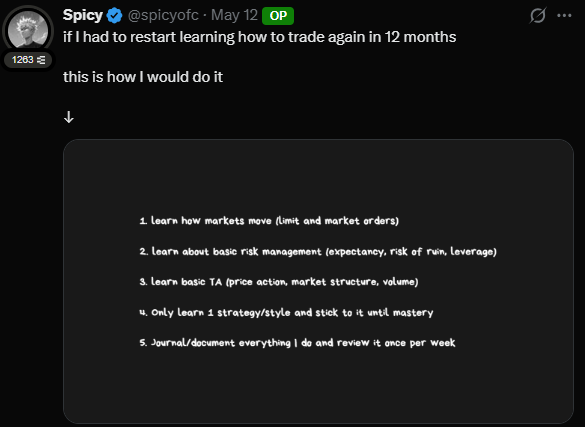
If I had to restart learning how to trade again in 12 months
- learn how markets move (limit and market orders)
- learn about basic risk management (expectancy, risk of ruin, leverage)
- learn basic TA (price action, market structure, volume)
- only learn 1 strategy/style and stick to it until mastery
- journal/document everything I do and review it once per week
1. Learn how markets move (limit and market orders)
Markets run on buyers and sellers placing orders. There are two basic order types:
- Market order — buy/sell immediately at the current price. Fast, but you have no control over your entry price.
- Limit order — place an order waiting at a specific price. More deliberate, lets you get a better price, but the order may never fill.
👉 Understanding these two order types = understanding how money flows in and out of the market.
2. Basic risk management (expectancy, risk of ruin, leverage)
- Expectancy — On average, does each trade make or lose money? A good strategy needs positive expectancy: profits outweigh losses over the long run.
- Risk of ruin — If you keep losing, how long before you run out of capital? Risk too much per trade → blow up fast, even with a good strategy.
- Leverage — Lets you trade with more than your actual capital. Bigger potential gains, but losses are multiplied equally. Misuse it and you self-destruct.
👉 Risk management matters more than strategy — lose less, stay in the game longer, and you give yourself a real chance to win.
3. Basic technical analysis (price action, market structure, volume)
- Price action — Read candlestick charts to understand market psychology: who is in control, buyers or sellers?
- Market structure — Is the market trending up, trending down, or ranging? Identify the bigger trend before entering a trade.
- Volume — Trading volume confirms the strength of a move. Price up + high volume = real move. Price up + low volume = be skeptical.
👉 These three elements help you read the market’s “language” instead of guessing.
4. Learn only one strategy/style and stick with it until mastery
Beginners often fall into “strategy hopping” — jumping to whatever looks good, never committing to anything long enough to get results.
Pick one approach (e.g. breakouts, support/resistance, trend following) → practice long enough → only then will you know if it actually works for you.
👉 Discipline matters more than finding the “perfect strategy.”
5. Document everything and review it once a week
A trading journal is the most powerful tool for improvement. Log: your reason for entering, your emotions at the time, the outcome, what went wrong. At the end of each week, sit down and review to find patterns in your own behavior.
👉 No journaling = no idea where you’re going wrong = repeating the same mistakes forever.
These five points are not about finding a “winning tip” — they are about building the foundation to survive and improve in trading over the long run.